Aug 28, 2026
HR in a Digitalized World: Balancing Risk and Human Connection
.jpg)
Parisa Peikareh


Germany’s defense sector is undergoing a period of significant industrial transformation. At the center of this shift is the SME (Mittelstand), the network of highly specialized small and medium-sized enterprises that has long defined the country’s industrial strength.
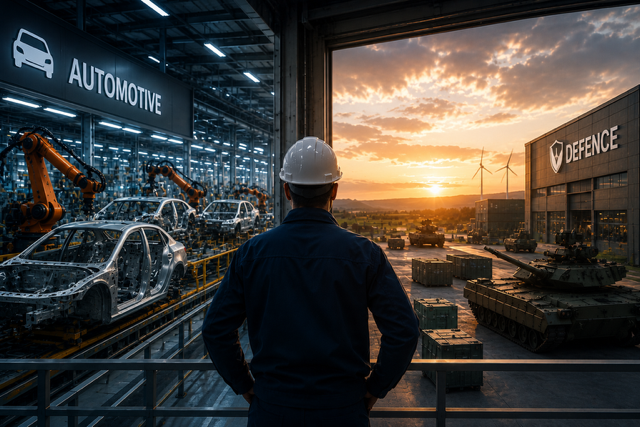
Once known primarily as precision suppliers to civilian industries, many of these companies are now becoming increasingly important contributors to Europe’s defense modernization. This development reflects a broader convergence between civilian innovation and defense capability. Technologies originally developed for automotive engineering, aerospace, medical devices, industrial automation, and digital manufacturing are increasingly relevant to modern defense systems.
Rather than operating in isolation, these companies are embedded within a multi-layered supply chain that connects national ministries, prime contractors, system integrators, and niche technology providers.
As a result, the same qualities that have made German SMEs globally competitive such as technical depth, reliability, and long-term specialization, are becoming strategically important across the defense supply chain.
From Niche Engineering to MissionCritical Capability
The defense supply chain in Germany is not defined primarily by vertical integration, but by specialization across multiple tiers. Large system integrators and prime contractors remain responsible for overall platform development and system coordination. However, a significant portion of technological performance is enabled by smaller specialized suppliers operating within clearly defined technical domains.
Germany’s industrial landscape is characterized by companies that dominate highly specific technological niches. Many of these firms have spent decades refining expertise. In practice, SMEs contribute to areas such as:
What is changing today is not the existence of this expertise, but its application. These technologies have become core elements of modern defense platforms, which rely on integrated systems rather than standalone components, where performance depends on the interaction between hardware, software, and subsystem integration.
As systems become more interconnected, the distinction between civilian and defense innovation continues to narrow. Within this environment, German SMEs operate in critical segments of the defense industrial ecosystem, particularly where dual-use technologies developed in civilian industries are adapted for defense applications.
Research institutions such as the Fraunhofer Society and industry organizations including the Federation of German Industries (BDI) have repeatedly highlighted the growing importance of dual-use innovation and industrial resilience for Germany’s long-term technological competitiveness.
Strengthening Supply Chain Resilience
Recent geopolitical developments have increased attention on secure, diversified, and resilient supply chains across Europe’s defense sector. Governments and major contractors are reassessing dependencies on concentrated production networks and external suppliers, particularly in strategically sensitive technologies.
In this environment, Germany’s decentralized industrial structure offers a distinct advantage. A broad network of highly specialized suppliers, many of them family-owned and regionally rooted, contributes flexibility and technical depth across industrial sectors.
This distributed model supports resilience in several ways:
For defense manufacturers, resilience is no longer understood solely in logistical terms. Increasingly, it also includes technological sovereignty, supplier diversification, and long-term industrial capability within Europe. As a result, SMEs are becoming increasingly important not only as suppliers, but also as stabilizing elements within the broader defense industrial base.
A Strategic Pillar of Europe’s Security Architecture
Germany’s specialized SMEs are no longer peripheral contributors to the defense value chain. They are becoming essential enablers of innovation, industrial resilience, and technological capability across Europe’s security landscape. Their role is defined less by production volume and more by specialization, technical depth, and long-term industrial expertise.
In an environment where defense systems are becoming more technologically integrated and operational requirements continue to evolve, highly specialized suppliers are playing a growing role in shaping the industrial foundations of European defense.
For stakeholders across the defense ecosystem, understanding this transformation is critical. It is reshaping supply chains, accelerating technological convergence, and redefining the industrial foundations on which Europe’s security will depend in the years ahead.
.png)
